

OPC Requirements for High-Risk Areas in Food Processing Plants
Open plant cleaning (OPC) — cleaning equipment and surfaces in place, without dismantling or moving them into a CIP system — is never a one-size-fits-all
task. It is least forgiving in the hardest place in a food factory: the high-risk area. Here, product is exposed after a validated kill step, workers are dressed to a
higher standard, and a single hygiene failure can put ready-to-eat food directly at risk.
Here explains what defines a high-risk area, what OPC actually requires there, and how to match the right cleaning equipment to those requirements —
drawn from BRCGS Issue 9, hygienic design guidance, and the environmental monitoring practice that underpins it all.
What Counts as a High-Risk Area?
BRCGS defines a high-risk area as "a physically segregated zone, designed to a high standard of hygiene, where practices relating to personnel, ingredients,
equipment, packaging and environment aim to prevent product contamination by pathogenic micro-organisms" .
The definition matters because of one word: prevent — as opposed to minimize, which is what applies in a high-care area.
For an area to qualify as high-risk, the product must meet all of the following conditions:
The finished product requires chilled or frozen storage to protect food safetyBefore entering the zone, all ingredients have received a full cook — heat
treatment of at least 70 °C for 2 minutes or an equivalent processThe finished product can support the growth or survival of pathogens (such as Listeria) that
could then grow during normal storage or useThe finished product is ready-to-eat or ready-to-heat, or could be consumed without thorough cooking
Typical high-risk products include sliced cooked meats and fully cooked foods.
The UK Chilled Food Association's framework adds useful precision: a high-risk area is where components have been heat treated to at least 90 °C for 10
minutes (for psychrotrophic Clostridium botulinum spores) or 70 °C for 2 minutes (for vegetative pathogens), and all components have received a minimum
6-log reduction in vegetative microorganisms.
Requirement 1: Segregation Comes First — OPC Operates Inside a Barrier
Before any cleaning procedure matters, the area itself must be physically separated. BRCGS requires that where a high-risk area forms part of a production
site, a physical segregation barrier be installed between it and the rest of the factory.
Crucially, the isolation must account for all of the following:
Product flowThe nature of materials, including packagingEquipmentPersonnelWaste handlingAir flow and air qualityUtility provision, including drains
For OPC, the practical consequence is direct: the cleaning method must not itself break the barrier. Drains flow from high-risk out to lower-risk areas, never the
reverse; cleaning equipment stays inside the zone; and the airflow pattern is maintained while cleaning occurs.
Requirement 2: Cleaning Procedures Must Reflect the Risk Level
This is the core OPC requirement. BRCGS clause 8.5.1 states that environmental cleaning programmes in high-care and high-risk areas must consider the
different microbiological risks associated with each production risk zone. At minimum, high-risk and high-care cleaning procedures must include all the
requirements of clause 4.11.2 — and cleaning frequency and method must be risk-based, with procedures in place to ensure the appropriate cleaning standard
is achieved.
A high-risk area cannot inherit the cleaning schedule of a GMP zone and call it done. It needs its own risk-based frequency and method.
Requirement 3: Define and Verify Microbiological Limits
BRCGS clause 8.5.2 requires that acceptable and unacceptable microbiological limits for cleaning operations be defined for high-risk and high-care production
risk zones — based on the potential hazard associated with the product or processing area.
Acceptable cleaning levels must be determined, as appropriate, by:
- Visual inspection
- ATP bioluminescence
- Microbiological testing
- Chemical testing
The site must also define corrective actions when results exceed acceptable limits. And where cleaning and disinfection procedures form part of the
prerequisite programme controlling a specific hazard, the procedure and its frequency must be validated and records maintained — including the risk of
chemical residues from cleaning chemicals on food-contact surfaces.
Requirement 4: Dedicated, Hygienically Designed Cleaning Equipment
BRCGS clause 8.5.3 imposes specific requirements on cleaning equipment used in high-care and high-risk areas. It must be :
Visually distinguishable in appearanceDedicated to those areas — used nowhere elseDesigned to hygienic standards and fit for purposeCleaned and stored
hygienically to prevent contamination — for example, stored off the floor when not in use
This is where many plants fail: colour-coded equipment exists but migrates between zones, or brushes and squeegees are stored wet on the floor of the very
area they are meant to protect.
Requirement 5: CIP Boundaries Must Be Controlled
Where a plant uses CIP equipment, BRCGS clause 8.5.4 requires that it be used only in specific areas — or that its design and control ensure it does not
introduce a contamination risk to high-risk or high-care areas. The flow must be controlled from high-risk/high-care areas toward lower-risk areas, and rinse
liquid must not be recovered or re-used between zones.
Requirement 6: Personnel and Materials Entering the Zone
The segregation barrier only works if what crosses it is controlled. BRCGS Issue 7 sets out that the barrier must prevent cross-contamination risk arising from:
Pathogens that may be present on products or ingredients that have not received a full cookAll personnel moving between the high-care area and other areas
— except through designated changing areasAll equipment, utensils and materials moving into the area — except through designated ports with disinfection
controlsWater or other liquids washing across the floor into the areaAirborne contaminants such as dust particles and water droplets
For new plants requiring high-care protection facilities, full-wall segregation should be used .
Requirement 7: OPC Method — The Four Cleaning Variables
Within the zone, the physical cleaning method still rests on four interdependent variables: mechanical action, chemistry, time, and temperature. Getting three
right does not compensate for the fourth.
Mechanical action dislodges soil physically; foam clings to vertical surfaces where a thin liquid would run off.Chemistry must match the soil. Alkaline foam
removes fats, oils, blood, and protein; acid foam removes scale and water spots. They are not interchangeable.Time — the chemicals need contact time to wet,
penetrate, and lift soil. Residue left behind both feeds bacteria and reduces the effectiveness of the disinfection that follows.Temperature speeds the reaction
and softens fats, within the equipment's rated limits.
And on disinfection, the concentration and contact time must match the soil condition. Typical target-surface figures illustrate the difference: chlorine-based
disinfectant at 100–250 mg/L for 10–30 minutes in clean conditions versus 400–700 mg/L for 10–30 minutes when soil is present; quaternary ammonium at
200–1,000 mg/L for 1–10 minutes clean versus 400–1,200 mg/L for 5–20 minutes contaminated. Effectiveness also falls as organic load rises or pH moves
away from optimum — one phenolic disinfectant's effect dropped sharply at pH 9.0.
Requirement 8: Verify With Environmental Monitoring
OPC in a high-risk area cannot be assumed — it must be verified. Environmental monitoring should target the places where control most likely fails. Practical
guidance suggests focusing on:
The most critical areas, including between the kill step and final packagingTransition areas and the barriers between raw and ready-to-eat zonesAreas where
conditions suit microbial growth or survival — bearing in mind the four requirements for microbial growth: water, food, time, and temperatureAreas where
pathogens have been found in the past
Sampling points can be tiered: while Zone 1 (direct food-contact surfaces) is the most critical, most sampling points sit in Zones 2 and 3, with a few in Zone 4
— so pathogens are detected and eliminated before they reach Zone 1.
Practical detection hints are useful here. Listeria is commonly found in chiller condensate, standing water, cooler walkways, walls, doors, shelving, ice
machines, and wet insulation. Salmonella is commonly found in dry food build-up, wet areas, edges and corners, roof leaks, and near exits.
Matching WONE Equipment to High-Risk OPC Requirements
The requirements above translate into specific equipment needs: dedicated, hygienically designed cleaning tools; chemistry matched to soil type; controlled
pressure and temperature; and data that supports validation. WONE's intelligent foam cleaning machine range (EFC-325 series) is built around exactly these
needs.
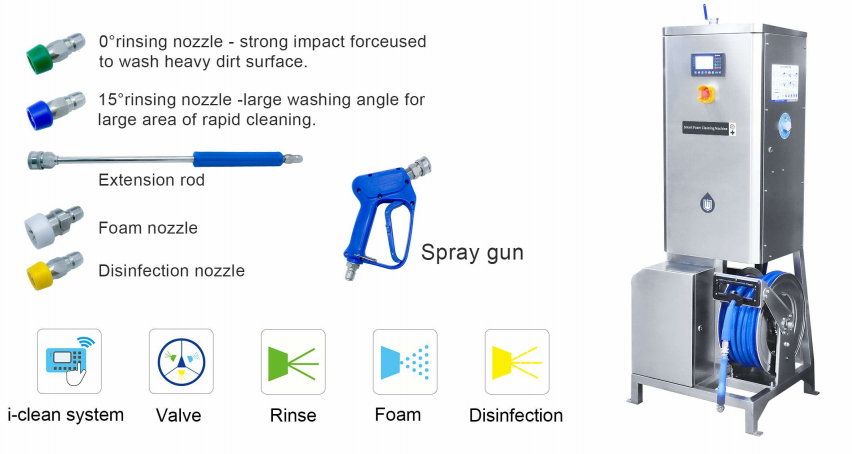
EFC-325H — Fixed-Installation Intelligent Foam Cleaning Machine
It integrates high-pressure rinsing, alkaline foam, acid foam, and disinfection in one unit — the chemistry matching that OPC requires.
|
Specification |
EFC-325H |
|
Working voltage |
380V/50Hz (waterproof aviation plug) |
|
Main functions |
High-pressure water, acid/alkali foam, disinfection |
|
Power |
4KW (5×1.5mm² cable) |
|
Rinsing pressure |
20 bar |
|
Hose |
Auto reel, 25m food-grade hose |
|
Water source |
Flow ≥3m³/h, 1" pipe, 2–5 bar, ≤60 °C |
|
Air connection |
8mm air hose |
|
Weight |
146KG |
|
Dimensions |
L730×W615×H1745mm |
Both are built in full 304 stainless steel, including a fully sealed 304 electrical box, with all internal piping connected by clamp quick-release fittings for easy
disassembly and maintenance — directly supporting BRCGS 8.5.3's requirement for equipment "designed to hygienic standards" .
The i-clean Controller — The Validation Tool for Requirement 3
Requirement 3 demands defined limits, records, and corrective actions. The 7-inch i-clean intelligent controller on the EFC-325 series is built for this: it
provides energy-consumption statistics (water, electricity, chemicals), cleaning-time statistics, and alarm records, plus colour screen and voice human-machine
interaction and voice prompts when switching modes. Chemicals are protected by a locked storage design, and a six-stage concentration valve allows precise
dilution control, with five-position multi-function valve one-touch switching between the four cleaning liquids and colour-coded quick-release nozzles.
That combination maps onto the requirements point by point: recorded cleaning time (documentation), alarm records (corrective action trigger), concentration
control (consistent chemistry), and colour-coded nozzles (dedicated, distinguishable equipment).
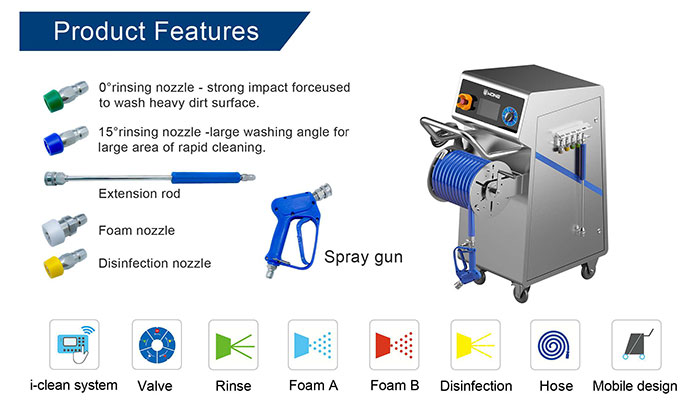
EFC-325W — Mobile Foam Cleaning Machines
|
Specification |
EFC-325W |
|
Working voltage |
220V/50Hz (waterproof aviation plug) |
|
Main functions |
High-pressure water, foam, disinfection |
|
Power |
3000W |
|
Outlet pressure |
20 bar (max) |
|
Water inlet |
3/4" quick connector + 3m hose |
|
Hose |
15m standard / extension |
|
Water source Flow |
≥3m³/h, 3/4" pipe, 2–5 bar, room temp |
|
Weight |
136KG |
Where high-risk zones need a dedicated mobile unit that can be moved between cleaning points but stays within the zone, the mobile models fit:
Both use full 304 stainless steel with hygienic, waterproof design, quiet large rubber casters and ergonomic handles for easy movement, stainless steel
manual hose reels, colour-coded quick-release nozzles, and the six-stage chemical concentration valve for precise dilution of alkaline and acid foams . They
are recommended for central kitchens and meat processing where there are multiple cleaning points and a small working range — the profile of many high-risk
and high-care areas.
Foam chemistry is dosed through the machine's concentration valve at 1–10%, with a foam expansion ratio up to 30x and a micron-scale, long-dwell foam that
clings to vertical surfaces — extending contact time without extra labour.
Proven in Real High-Risk and High-Care Facilities
The EFC-325 series is already deployed across meat processing, poultry products, aquatic products, prepared dishes, and central kitchens — the product
profiles that most often include high-risk zones.
A Practical OPC Checklist for High-Risk Areas
1. Confirm the barrier — physical segregation intact, drains flowing outward, transfer points controlled
2. Write a zone-specific procedure — frequency and method based on risk, not inherited from GMP zones
3. Set microbiological limits — with visual, ATP, microbiological, and chemical verification, and defined corrective actions
4. Validate the procedure — and keep records, including chemical residue risk on food-contact surfaces
5. Dedicate cleaning equipment — visually distinct, zone-specific, hygienically stored off the floor
6. Control CIP boundaries — flow from high-risk to lower-risk, no cross-zone recovery of rinse liquid
7. Apply the four cleaning variables — mechanical action, matched chemistry, contact time, correct temperature
8. Match disinfectant concentration to soil condition — and respect contact time
9. Sample where failure is likely — Zone 2 and 3 first, targeting water, food, time, and temperature
10. React to positives — with a pre-prepared corrective action plan that finds the source and proves control is restored
OPC in a high-risk area is not just "cleaning, but more often." It is a different discipline: it operates inside a physical barrier, follows a risk-based procedure with
defined microbiological limits, uses dedicated hygienically designed equipment, respects controlled flow boundaries, and is verified by environmental
monitoring that targets the places where pathogens actually hide.
The reason is simple. In a high-risk area, product has already been through its kill step — so it has no further protection. Every requirement above exists to
ensure that nothing introduced after that step becomes the reason a ready-to-eat product fails. Choosing equipment that is 304 stainless, hygienically designed
, dedicated to the zone, and capable of recording its own cleaning data turns those requirements from paperwork into daily practice.
To build a cleaning and disinfection programme for your high-risk zones, contact WONE.


