

Does Your Food Processing Facility's Hand Hygiene Machine Feature Quantitative Soap Dispensing Control?
In the hygiene management within food processing plants, hand cleaning and sanitizing serves as the primary line of defense against cross-contamination. However, the hand hygiene
equipment in many facilities remains stuck in a rudimentary stage—merely providing "equipment that works"—while overlooking the critical detail of controlling the amount of soap or
disinfectant dispensed. The absence of quantitative dispensing control means that the cleaning efficacy of each hand wash, chemical consumption levels, and even operational costs all
fall into an uncontrollable "blind spot." Evaluating whether your hand hygiene equipment possesses this specific feature serves as a crucial benchmark for assessing both its
effectiveness and the overall standard of your facility's hygiene management.
Why Is Quantitative Control So Critical?
1. Ensuring Consistent Cleaning Efficacy:
Effective hand cleaning requires a sufficient—yet not excessive—amount of soap. Insufficient soap fails to adequately emulsify grease and dirt, resulting in incomplete cleaning;
conversely, excessive soap leads to poor rinsing, leaving chemical residues that could potentially contaminate food products or irritate the skin. Quantitative control ensures a consistent
dispensing volume for every use (e.g., 0.5 ml per person), thereby providing a repeatable and verifiable physical foundation for "effective hand washing.
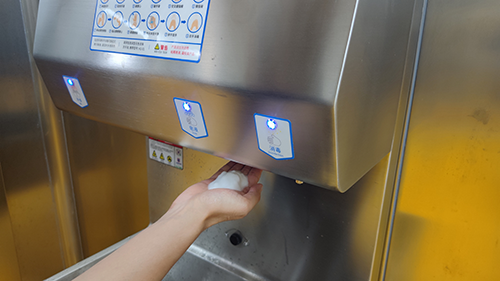
2. Enabling Precise Management of Chemical Costs:
Hand soap represents a recurring operational expense for any facility. Without quantitative control, employees tend to press the dispenser for arbitrary durations, making waste highly
probable. Consider, for instance, a dispenser used by 50 employees: if each person uses just 1 ml of extra soap per wash—and washes their hands twice daily—the facility will incur an
additional monthly consumption of approximately 3 liters of soap.
.png)
.png)
3. Supporting Compliance and Data Traceability:
Modern food safety standards (such as BRCGS and FSSC 22000) emphasize data-driven decision-making. Equipment featuring quantitative control capabilities—such as WONE's
sensor-activated soap dispensers—typically integrates liquid-level sensors and metering units. These systems not only provide alerts when soap levels are low but also compile
consumption data. This data can be cross-referenced with employee attendance records to create a closed-loop log linking "hand washes performed" to "soap consumed," thereby
providing objective evidence for audits and demonstrating that hygiene protocols are being effectively implemented.
.png)
.png)
.jpg)
A review of the current industry landscape reveals that many factories still face significant challenges regarding hand hygiene facilities: manual soap dispensers allow for arbitrary usage
amounts, resulting in inconsistent cleaning effectiveness; rudimentary sensor-based devices lack data capabilities, rendering their management akin to a "black box"; and, most commonly,
equipment is poorly positioned or functionally limited, failing to compel employees to execute complete, standardized hygiene protocols—thereby reducing critical hygiene procedures to
mere formalities.
WONE's intelligent hand hygiene equipment was designed specifically to address these pain points, elevating hand hygiene from a "basic utility" to a "strategic control
point."
1. Mandatory and Guided Design:
WONE's Soap Dispensing Turnstiles (PHS-11S) and Personnel Hygiene Stations (e.g., PBW-24, PBW-41E) incorporate integrated turnstile access logic. Employees are granted passage
through the turnstile only after completing the full sequence of sensor-activated soap dispensing, hand washing, hand drying, and sanitizing. This physically guarantees 100% compliance
with the hygiene protocol, perfectly meeting the rigorous audit requirements for "mandatory enforcement" and "procedural integrity."
2. Precise Dosing and Cost Control:
At the core of our sensor-activated devices lies precise dosing pump technology. Each dispense delivers a consistent, standardized volume (e.g., 0.5ml), ensuring effective cleaning while
simultaneously eliminating waste. Coupled with the intelligent controller's liquid level monitoring and consumption tracking capabilities, factory managers gain clear visibility into soap
usage data—transitioning from "vague consumption estimates" to "precise resource management" and directly optimizing operational costs.
3. High Integration and Space Optimization:
From the PHW-F3E series—which integrates hand washing, drying, and sanitizing into a single unit—to the compact PBW-41E Personnel Hygiene Station, which combines hand cleaning
with footwear sanitizing, our equipment features highly integrated designs tailored to fit the spatial constraints of various workshop entrances. These units can be strategically deployed at
critical control points—specifically after changing areas but prior to entering clean zones—to establish an efficient and unavoidable hygiene barrier.
4. Data Traceability and Compliance Assurance:
All intelligent devices are equipped with comprehensive data logging capabilities. Information such as hand-washing frequency, equipment operational status, and low-fluid alerts can be
collected and managed, providing irrefutable digital evidence that enables factories to meet the "Monitoring and Verification" requirements stipulated in standards such as BRCGS and
FSSC 22000. This transition shifts hand hygiene management from reliance on subjective judgment and experience to an objective, data-driven approach.
From the high-protein, grease-laden environments of pet food manufacturing plants to the dust and sugar-oil mixtures found in bakeries, and extending to the complex contamination loads
inherent in meat processing,WONE's hand-washing equipment is engineered to tackle the unique challenges of every food industry sub-sector. Thanks to its robust 304 stainless steel
construction, contactless sensor-activated operation, dense-foam cleaning technology, and powerful intelligent core, our equipment delivers reliable performance across the board.
In a word, WONE offer far more than just standalone hand-washing units; we deliver a comprehensive, systemic hand hygiene solution that seamlessly integrates mandatory protocols,
precision control, intelligent management, and compliance verification. This solution empowers food manufacturing facilities to transform the fundamental requirement of hand hygiene into
a solid cornerstone of brand reputation and a distinct competitive advantage in the marketplace.
In todays—where food safety standards are constantly being refined—the true value of hand hygiene equipment lies not merely in the convenience of "automatic sensing," but rather in the
precise, manageable hygiene control capabilities that underpin it. Precise soap dispensing control stands at the very heart of this capability. It ensures that every hand-washing cycle is
effective, every operational cost is transparent, and every management process is data-driven. We invite you to evaluate your current equipment: Is it merely consuming resources vaguely,
or is it providing precise, reliable protection?


