

Automated Hygiene Stations vs Manual Handwashing in Certified Food Plants
In certified food plants adhering to stringent global standards like BRC, SQF, or ISO 22000, ensuring consistent personnel hygiene is not optional—it's a critical prerequisite for food
safety. Traditionally, this relied on manual handwashing at sinks equipped with soap, towels, and often a separate disinfectant station. However, the evolution towards Automated
Hygiene Stations represents a paradigm shift in how hygiene is controlled, monitored, and guaranteed. Understanding the contrast between these two approaches reveals why
automation is becoming the benchmark for modern, certified facilities.
I. Manual Handwashing: The Foundation with Inherent Gaps
The manual method is familiar: an employee approaches a sink, wets hands, applies soap, scrubs, rinses, dries, and may get a disinfectant. Its success hinges entirely on individual
compliance—the employee's knowledge, diligence, and time commitment. While effective when performed perfectly, this system suffers from significant vulnerabilities:
1. Inconsistency:
There is no enforcement of scrub duration (e.g., the recommended 20 seconds), technique (e.g., covering thumbs and fingernails), or sequence. A rushed rinse undermines the
entire process.
2. Unverifiable Compliance:
Did the employee actually wash? Did they dry properly before disinfecting? Management cannot objectively verify each event, relying on sporadic audits and hope.
3. Cross-Contamination Risk:
Touching manual taps, soap dispensers, and towel handles with unclean or wet hands can re-contaminate them, negating the wash's purpose.
II. Automated Hygiene Stations: Engineered Consistency and Control
 |
| 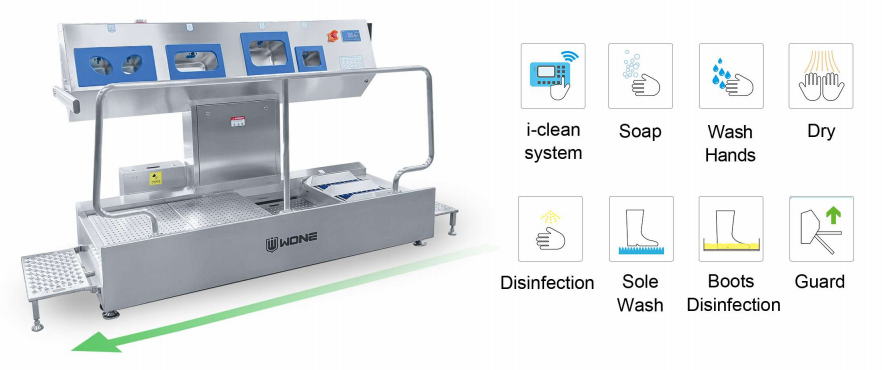
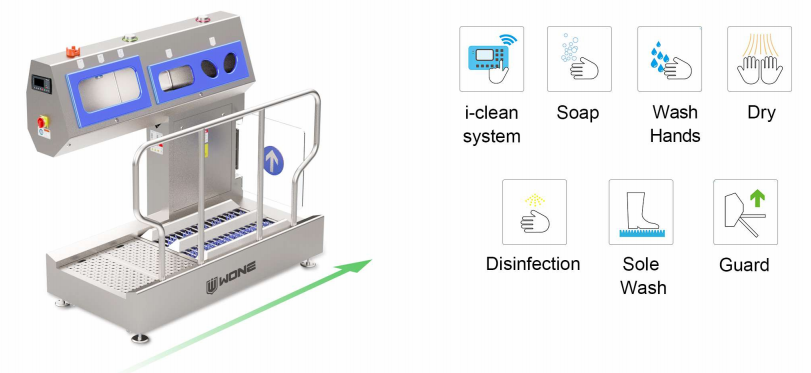
Devices like integrated Personnel Hygiene Stations (e.g., WONE's PBW series) transform hygiene from a voluntary act into a controlled, verifiable process. These stations typically
integrate handwashing, drying, sanitizing, and often simultaneous boot cleaning and disinfection into a single, guided sequence.
Their superiority lies in engineered control:1. Process Enforcement:
Using sensors and programmed logic, the station guides the user step-by-step with voice and light prompts. It will not proceed to the next step (e.g., from rinsing to drying) unless
the previous one is completed for a set duration, enforcing correct scrub and dry times.
2. Elimination of Cross-Contact: Fully non-contact, sensor-operated faucets, soap dispensers, dryers, and disinfectant sprays ensure clean hands touch nothing until the process is
complete.
3. Data-Driven Verification: Advanced models feature intelligent controllers (like i-clean systems) that log usage data, count compliant entries, monitor chemical consumption, and
even flag low supplies. This creates an auditable trail, proving to certifiers that hygiene protocols are consistently followed.
4. Integrated Efficiency:
By combining hand and footwear sanitation in one streamlined flow, they save space and time while ensuring a holistic "clean entry."
From Trust-Based to Trust-Verified Systems
For certified food plants, the core difference is philosophical. Manual handwashing operates on a trust-based model, hoping that training and signage will yield perfect compliance every time. Automated Hygiene Stations implement a trust-verified model, where the system itself guarantees the standard is met and provides the data to prove it.
While manual facilities meet baseline code requirements, automated stations actively manage and mitigate the human variable—the greatest risk in any hygiene program. They don't just facilitate cleaning; they engineer a reliable, documented, and defensible hygiene barrier, making them the definitive choice for food plants committed to demonstrable excellence in food safety.


