

Is boot cleaning necessary in food plant?
In food processing plants, boot cleaning is not only an important hygiene measure but is also, in many cases, a mandatory requirement. Whether a shoe washing process is necessary
depends on specific regulations and standards, the factory's risk level, and the actual production environment.
I. Regulatory and Standard Requirements: Generally, "disinfection is mandatory," and "cleaning first" is strongly recommended.
1. Basic National Standard Requirements:
GB 14881-2013, "General Hygiene Standard for Food Production," Article 5.1.5.2 stipulates: "Shoe changing (wearing shoe covers) facilities or work shoe disinfection facilities should be
provided as needed at the entrance of the production workshop and in necessary areas within the workshop." The core is "disinfection." The standard does not directly mandate "cleaning,"
but disinfection requires relatively clean shoes. Severely soiled shoes will consume disinfectants, form biofilms, and lead to disinfection failure.
2. Industry and Higher Standard Requirements:
International standards such as BRCGS, AIB, and FSSC 22000 all emphasize effective control of shoes to prevent cross-contamination. These requirements typically include:
- High-risk/high-concern areas must require the use of dedicated shoes or effective shoe disinfection pools.
- The concentration and effectiveness of the disinfection pool must be monitored and verified.
- Logically, effective disinfection must be based on cleanliness. Many audit guidelines indicate that shoes heavily contaminated with dirt or organic matter will reduce disinfection effectiveness.
3. Local and Product-Specific Specifications:
Some local standards (such as DB44/T 1016-2012) explicitly specify the effective chlorine concentration in disinfection pools (e.g., 0.2%-0.3%).
In wet processing workshops, meat processing, and seafood processing, where contaminants and microorganisms are easily generated, there are usually stricter practical requirements for
shoe cleaning.
II. Necessity in Actual Production: Scientific Judgment Based on Risk
Even if regulations do not explicitly state "must wash," shoe washing is a crucial risk control measure in the following scenarios:
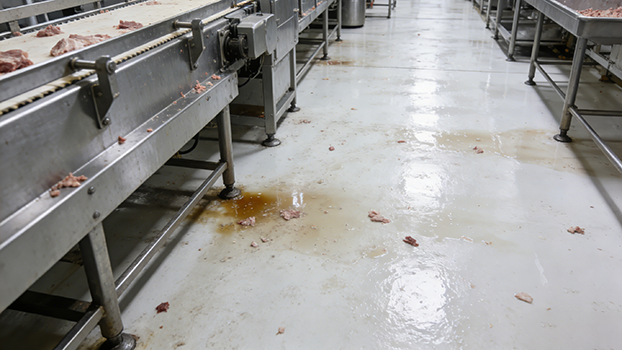
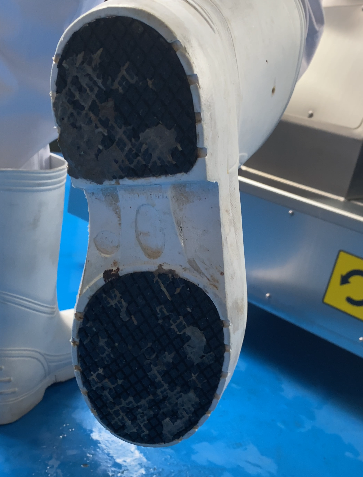
1. The workshop floor has obvious contaminants: such as grease, meat scraps, flour, sauces, stagnant water, etc. Failure to promptly clean shoes upon leaving the workshop will carry
contaminants into the changing room and contaminate the disinfection pool upon re-entry, creating a vicious cycle of cross-contamination.
2. This applies to high-risk products such as ready-to-eat foods, infant formula, and sterile products. Footwear, as a significant source of microbial and foreign matter contamination,
requires a correspondingly higher level of cleanliness control.
3. Cross-contamination between dry and wet areas: When employees move between dry areas (e.g., packaging rooms) and wet areas (e.g., washing rooms), dirt from the wet areas can
be carried to the dry areas, increasing the risk of contamination.
4. Improving disinfection effectiveness: Cleaning removes a large amount of organic matter and biofilm, making subsequent chemical disinfection (foot baths) or physical disinfection
(ultraviolet light) truly effective.
III. Best Practice Recommendations: Establish a Closed-Loop Management System for "Cleaning-Disinfection"
A complete footwear hygiene procedure should follow the logic of "cleaning upon leaving the workshop, disinfecting upon entering the workshop":
1. Upon leaving the workshop (mandatory or recommended cleaning):
Purpose:
- To prevent contaminants from the workshop from being carried into the changing room and outside.
Facilities:
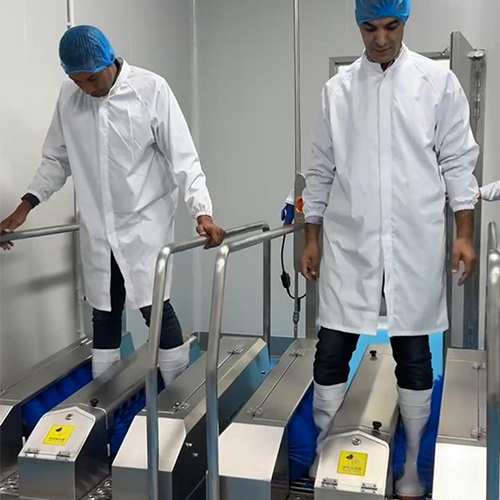
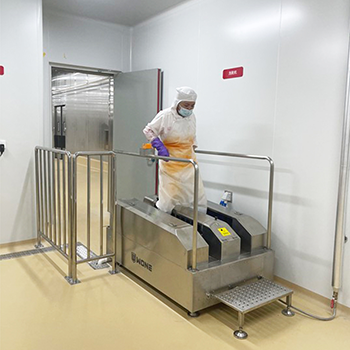
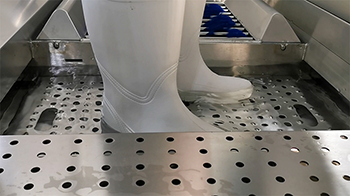
- Install a walkway-style or stand-alone footwear washing machine at the workshop exit. This effectively removes dirt from shoe soles, maintains a clean changing room environment, and reduces the burden of subsequent disinfection.
2. Before entering the workshop (disinfection is mandatory):
Purpose:
- To kill or reduce microorganisms brought in from outside.
Facilities:
- Set up a standard-compliant shoe disinfection pool or a smart sanitation station with disinfection functions at the workshop entrance. Ensure the disinfectant concentration is correct
- and the soaking time is sufficient.
From a compliance perspective, "disinfection" is an explicit requirement, while "cleaning" is an implicit prerequisite and best practice. From a food safety risk control perspective, in most
food factories, especially those with wet operations, high-risk products, or complex personnel and material flows, establishing a systematic shoe cleaning procedure is a necessary and
efficient investment. It not only directly reduces the risk of cross-contamination but also significantly improves the effectiveness of disinfection measures and demonstrates the factory's
proactive control over detailed risks during rigorous audits such as BRCGS.


