

Five GMP Requirements for Handwashing Sinks
In the meticulously controlled world of Good Manufacturing Practice (GMP), every element of the facility is a cog in the machinery of quality and safety.
While advanced equipment and sterile environments capture the imagination, one of the most critical lines of defense against contamination is often the
most humble: the handwashing sink. Far from being a mere utility, the handwashing station is a strategic control point. Its design, placement, and
maintenance are not afterthoughts but fundamental requirements detailed in GMP guidelines worldwide. Failure here can undermine the entire quality
system. Here are five non-negotiable GMP requirements for handwashing sinks that every manufacturing facility must rigorously implement.
1. Strategic Placement and Adequate Number
A sink behind a closed door or at the far end of a production room is functionally useless. GMP principles demand that handwashing sinks be accessible
and conveniently located at key entry and exit points. This includes:
- Entrances to production, packaging, and quality control areas: Personnel must wash hands before entering any critical zone.
- Adjacent to restroom exits: To enforce hand hygiene post-restroom use.
- Within the gowning area: As a defined step in the gowning procedure before donning sterile or protective garments.
.png)
Furthermore, there must be a sufficient number of sinks to prevent queues and discourage personnel from bypassing the wash step due to inconvenience.
The calculation considers the number of employees, shift changes, and workflow to ensure the process is efficient and unavoidable.
2. Hands-Free Operation
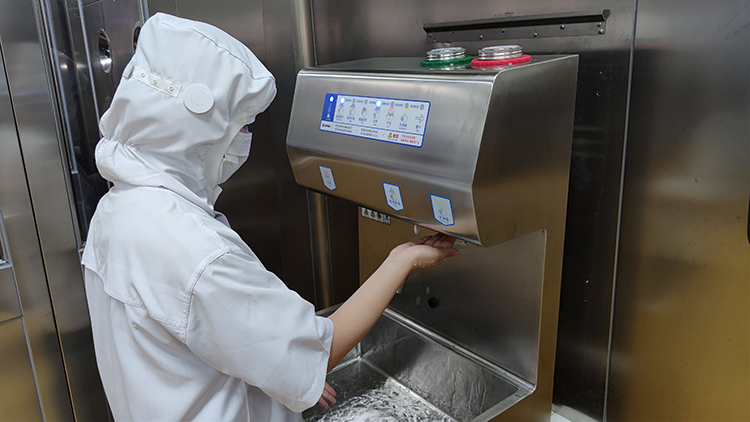
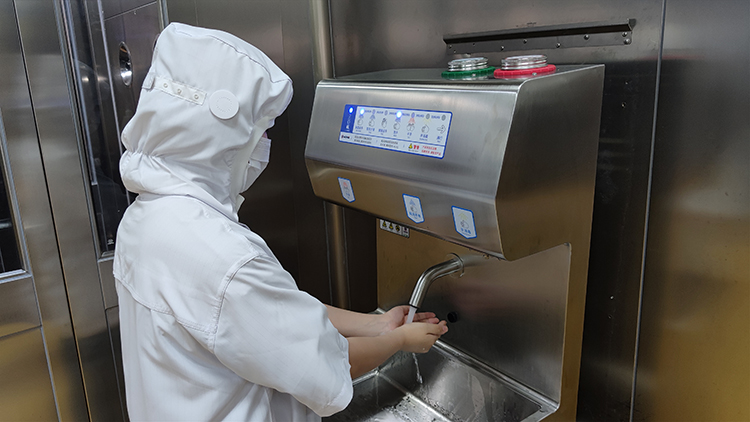
To prevent re-contamination of cleaned hands, GMP mandates hands-free operation. This is achieved through sensor-activated faucets or foot/knee
pedals. The logic is impeccable: an operator cannot turn off a manually-operated faucet with dirty hands after washing without re-contaminating them.
Similarly, soap and sanitizer should be provided via wall-mounted, no-touch dispensers. This requirement closes a critical loop in the handwashing
procedure, ensuring that the act of washing does not itself become a source of cross-contamination. The use of hands-free fixtures also promotes water
conservation and maintains a cleaner sink area.
3. Design for Hygiene and Dedicated Use
The sink itself must be designed for a sanitary environment. It should be made of smooth, non-porous, and corrosion-resistant materials (like stainless steel)
with coved edges for easy cleaning and disinfection. Sharp corners or porous surfaces can harbor biofilms and soil.
Crucially, GMP requires that handwashing sinks be dedicated to handwashing only. They must not be used for washing equipment, disposing of solutions,
or any other purpose. This rule prevents the introduction of chemical residues, particulates, or microbial loads from tools or materials into the sink basin,
which could then aerosolize or splash onto personnel or nearby surfaces. A sign clearly stating "For Handwashing Only" is often a basic regulatory
expectation.
4. Specified Supplies and Proper Drainage
The availability of effective cleaning agents is paramount. Sinks must be stocked with:
- A mild, effective antibacterial soap.
- Single-use, disposable paper towels (or another hygienic drying method like air dryers proven suitable for the classified area). Common cloth towels are strictly prohibited.
- A dedicated, hands-free waste receptacle for used towels.
Drying is a critical step, as wet hands can transfer microorganisms more easily than dry ones. Furthermore, sinks must have floor drains that are not directly
under the sink and are designed to prevent backflow. The drain should be easy to clean and maintained to avoid standing water, which can become a
breeding ground for microbes and attract pests.
5. Clear Procedures, Signage, and Maintenance
The physical infrastructure is only half the battle. GMP requires clear, validated procedures for how to wash hands (often following WHO or similar guidelines
: wet, lather, scrub for 20-30 seconds, rinse, dry). This procedure must be communicated through laminated signage posted visibly at each sink.
Finally, a robust maintenance and monitoring schedule is essential. This includes:
- Regular cleaning and sanitization of the sink, faucet, and surrounding area.
- Frequent checks to ensure soap and towel dispensers are full and functional.
- Periodic verification of water temperature and quality.
- Documentation of all cleaning and maintenance activities.
A clogged, poorly stocked, or dirty sink sends a powerful negative message about the facility’s culture of quality. It becomes a visible indicator of systemic
neglect.
The Sink as a Sentinel
In GMP-regulated industries, the handwashing sink is a sentinel guarding the production process. Its requirements—strategic placement, hands-free
operation, dedicated hygienic design, proper supplies, and supported by clear procedures—are not arbitrary. They are the practical application of
science-based risk management. By treating these five requirements with the seriousness they deserve, companies do more than just pass an audit.
They embed a tangible culture of quality, demonstrating an understanding that patient and consumer safety truly does begin at the sink.


