

What Can a UVC Tunnel Disinfection Machine Disinfect in Food Plants?
Maintaining high hygiene standards is essential in food manufacturing. Every day, items such as food products, packaging materials, trays, crates, and tools move through different production
areas, creating potential pathways for cross-contamination. The UVC tunnel disinfection machine —also known as a UV conveyor system or UV tunnel—offers a non-chemical, residue-free
solution for rapid surface disinfection.
What Is a UVC Tunnel Disinfection Machine?
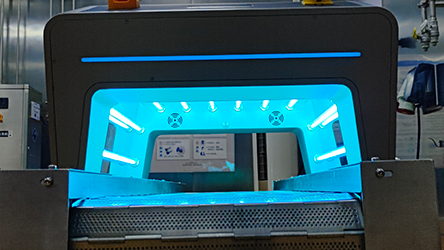
A UVC Tunnel Disinfection Machine uses 254 nm UVC light to inactivate bacteria, viruses, molds, and other microorganisms on exposed surfaces. As items travel through the enclosed tunnel
on a conveyor, they are exposed to high-intensity UVC light from multiple angles, providing rapid surface disinfection without water or chemicals.
.png)
What Can It Disinfect?
A UVC tunnel is suitable for disinfecting a wide range of objects commonly used in food processing plants, including:1. Food Surfaces
Certain packaged or exposed food products can undergo UVC surface treatment to help reduce microbial contamination before packaging or further processing. Typical applications include
fruits, vegetables, bakery products, seafood, and other foods where UVC is suitable as part of the production process.
2. Packaging Materials (Primary and Secondary)
This is the most common application. UVC tunnels are widely used to decontaminate the outer surfaces of packaging materials before they enter the production or high-care area.
- Pre-formed containers, trays, cups, and lids – UVC reduces microbial load on plastic, aluminum, or composite packaging before filling.
- Flexible films and pouches – Roll-fed or pre-cut packaging materials can pass through a UVC tunnel on a conveyor belt.
- Secondary packaging – Cartons, boxes, and outer wraps entering the production zone.
The Hygienic Design of Food Factories guideline confirms that “dry systems, using UV light” are the preferred decontamination method when the surface of incoming material is relatively clean
, such as cans entering a high-risk slicing area.
3. Raw Ingredients and Outer Packaging
Certain raw materials and ingredients require surface decontamination upon entry into high-risk zones. The UVC tunnel can disinfect:
- Cans, jars, and bottles – Sealed containers of ingredients (e.g., corned beef cans, sauce jars) entering the production line.
- Vegetables and fruits (whole, intact) – GB 28235-2020 §6.3 confirms that UVC surface disinfection is applicable to “other object surfaces,” which includes intact produce.
- Sealed bags and pouches – Outer surfaces of ingredient sacks entering the clean area.
For wet-soiled surfaces, a spray decontamination tunnel is preferred; but for relatively clean, dry surfaces, the UVC tunnel is the recommended method, offering rapid processing without
chemical residues.
4. Food Contact Tools and Small Equipment
UVC tunnels are effectively used to disinfect non-porous tools and small equipment before use or between production runs:
- Knives, slicers, and cutters – Blades and cutting surfaces that contact food directly.
- Scrapers, spatulas, and tongs – Small hand tools used in food handling.
- Cutting boards and work surfaces – Small format boards that can pass through the tunnel.
- Measuring cups, scoops, and funnels – Utensils used in ingredient preparation.
According to GB 28235-2020 Table 3, UVC can achieve a ≥3.00 log reduction for Staphylococcus aureus and E. coli on object surfaces, making it highly effective for small equipment
disinfection.
5. Conveyor Components and Machine Parts
In continuous production lines, reusable conveyor components and machine parts can be decontaminated using UVC tunnels:
- Conveyor belts and chains – Small sections or modular belts can be routed through UV tunnels for continuous disinfection.
- Guide rails, rollers, and sprockets – Non-product contact parts that can transfer contamination.
- Change parts – Machine components swapped between product runs (e.g., forming dies, filling nozzles).
Why Choose UVC Disinfection?
Compared with manual chemical disinfection, a UVC Tunnel Disinfection Machine offers several advantages:
- Fast processing for continuous production lines
- Chemical-free disinfection with no residue
- Dry operation without water or drying time
- Automated and consistent treatment for every item
- Lower operating costs by reducing chemical consumption
Applications Across Food Industries
UVC Tunnel Disinfection Machines are widely used in:
- Meat and poultry processing
- Seafood factories
- Dairy plants
- Bakeries
- Beverage production
- Fruit and vegetable processing
- Ready-to-eat food manufacturing
- Frozen food production
A UVC Tunnel Disinfection Machine is an effective solution for disinfecting food surfaces, packaging surfaces, plastic crates, trays, processing tools, and production accessories**. By
combining automated operation with chemical-free UVC technology, it helps reduce cross-contamination, improve production efficiency, and strengthen food safety management.
As hygiene standards continue to rise, UVC tunnel disinfection is becoming an increasingly valuable part of modern food processing operations.
Looking for a reliable UVC disinfection solution?** WONE's UVC Tunnel Disinfection Machine delivers fast, automated, and chemical-free surface disinfection for food products, packaging,
and production equipment, helping food manufacturers build safer and more hygienic processing environments.


