

Is the location of your food factory's hygiene station appropriate?
In audits of international food safety standards such as BRCGS and AIB, the placement of hygiene stations (personnel hygiene and cleaning stations) is far more than
a simple matter of equipment placement. The appropriateness of their location is a key focus for auditors, directly impacting the effectiveness of the factory's hygiene
control system. An inappropriate location can render the entire personnel hygiene procedure ineffective and become clear grounds for issuing non-compliance notices.
I. Why does the audit focus so much on location? The core is risk control logic.
Auditors judge the appropriateness of a location based on a fundamental principle:
Does the location ensure that all personnel entering the controlled area complete the mandatory hygiene procedures 100% without omission before touching products
or clean surfaces? Any loopholes that could be bypassed or overlooked are unacceptable risks.
Common inappropriate locations and reasons for audit failure:
1. Location deviation or the existence of "shortcuts":
The hygiene station is not directly facing and adjacent to the only entrance to the controlled area (such as a clean work area or high-risk area). Employees may enter
directly through other channels (such as material doors or emergency doors), completely bypassing the hygiene procedures. This is one of the most serious flaws.
2. Located in the middle of the changing process:
For example, placing the hygiene station inside the "changing room." After changing into clean work clothes, employees wash their hands and disinfect their shoes,
potentially contaminating the already cleaned work clothes. The correct logic is: the hygiene station should be the last checkpoint before entering the workshop after
all changing steps.
3. Intersecting with logistics channels:
The channel where the hygiene station is located also serves as a material, tool, or waste channel. The personnel hygiene process intersects with logistics, posing a
very high risk of cross-contamination and violating the fundamental principle of "separation of people and materials."
4. Insufficient space leads to process failure:
Although the location is correct, the buffer zone in front is too small, causing personnel to touch walls or doors while queuing, or to touch unsterilized surfaces upon
turning around after disinfection, rendering the disinfection ineffective.
II. Core Standards and Best Practices for Reasonable Location
A hygiene station location that can withstand scrutiny should meet the following core standards:
1. Mandatory:
It must be the only physically necessary route to the target controlled area. This should typically be implemented in conjunction with an access control system (such as
interlocking doors or turnstiles) to ensure "no entry until completed."
 拷贝.jpg)
 拷贝.jpg)
 拷贝.jpg)
2. The process endpoint:
must be set after the individual has fully completed the changing process (including changing shoes, putting on hairnets, and donning work clothes). The standard
procedure should be: changing clothes completed → entering the hygiene station (hand washing/disinfection + shoe disinfection) → directly entering the workshop.
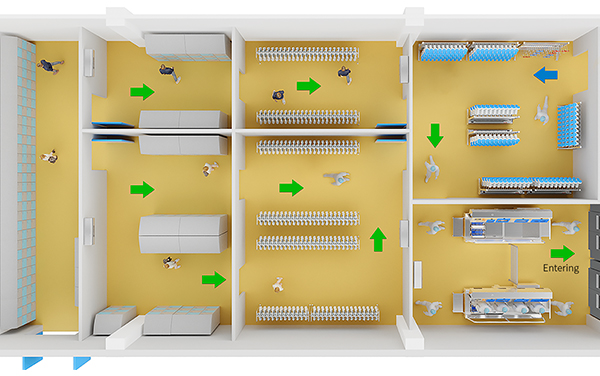
3. Risk isolation:
The area where the hygiene station is located should be clearly defined as a "hygiene buffer zone," physically separated from both external non-clean areas and
internal clean areas (e.g., walls, doors), and should not share material passages.
4. Ergonomics compliance:
Sufficient space should be provided for personnel to comfortably complete all actions, and clear "clean side" and "contaminated side" signage should be provided to
guide one-way traffic.
III. From "Reasonable Location" to "Effective System":
By observing the location of the hygiene station, auditors are essentially assessing the depth of the factory management's understanding of contamination path control.
A well-planned location conveys the factory's proactive risk identification and systematic management capabilities.
Therefore, during planning or renovation, factories should conduct flow simulations, examining the process from the perspectives of employees, visitors, and auditors
to ensure no loopholes exist. United Food Safety, when providing clients with hygiene stations, always prioritizes layout planning consultation as a pre-service,
precisely to help clients build a solid foundation for this crucial line of defense from the outset.
The location of a hygiene station is the decisive factor in its functional value. It is not a "device" that can be placed arbitrarily, but a "control point" that must be carefully
designed. Its rationality directly demonstrates whether a factory's hygiene system is merely "theoretical" or "effectively implemented," which is undoubtedly a key
factor that experienced auditors can easily discern.


