

Must Boots in Food Factory Be Cleaned? A Misunderstood Industry Controversy
In the hygiene management of food factories, the question of whether boots must be cleaned is often considered a point of contention. One side argues that national
standards only require "disinfection," and cleaning is an additional cost; the other side insists that disinfection without cleaning boots is ineffective. In fact, this is not a
simple "yes or no" debate, but a core issue concerning risk logic and technological effectiveness.
I. The Root of the Controversy: A Misalignment Between Standard Interpretation and Technological Reality
National Standard GB 14881-2013 focuses on the installation of "disinfection facilities" for footwear. This leads some factories to believe that as long as a foot disinfection
pool (foot bath) is installed, compliance is achieved. However, international advanced standards (such as BRCGS, AIB) and the consensus of sanitary engineering point
out that the effectiveness of disinfection is highly dependent on the premise of cleanliness.
When work boots carry a large amount of organic matter (such as grease, meat scraps, flour):
1. Disinfectant is consumed: Dirt quickly consumes the effective components in the disinfectant, causing a rapid decrease in concentration.
2. Forming a biological barrier: Dirt encapsulates microorganisms, forming a physical protective layer that prevents disinfectants from contacting and killing pathogens.
3. Contami nation transfer: Dirt on shoe soles can be carried from the production area into changing rooms, corridors, and even spread through disinfection pools,
creating a cycle of cross-contamination.
Therefore, the essence of the controversy lies in whether to meet the minimum compliance requirement of "having disinfection facilities" or to pursue the substantive risk
control of "effective disinfection."
II. Scenarios where boot washing is mandatory: Risk-based assessment
In the following high-risk scenarios, boot washing is no longer an "optional action," but a necessary step to ensure disinfection effectiveness and control cross-contamination:
1. Wet processing environments: In workshops handling meat, seafood, sauces, fruits, and vegetables, the floors are prone to blood, grease, and mud. Mandatory boot
washing upon leaving the workshop is a core measure to prevent the spread of contaminants.
2. Factories with mixed dry and wet areas: When employees move between dry packaging areas and damp pre-processing areas, dirt from the wet areas can become a
source of contamination in the dry areas.
3. For factories producing ready-to-eat foods or high-risk products, such as infant formula, cold meals, and sterile products, extremely high requirements are placed on
microbial control, necessitating the elimination of all possible contamination pathways.
For factories experiencing frequent disinfection pool failures: If the disinfection pool concentration is difficult to maintain, or microbial monitoring repeatedly exceeds
standards, the root cause is often an excessive organic load brought in by footwear. In this case, adding a boot washing step is the fundamental solution.
III. Best Practices:
Establishing a Closed-Loop Management System of "Cleaning-Disinfection" Advanced factory hygiene management has upgraded footwear control from a single
"disinfection point" to a dynamic "hygiene closed loop":
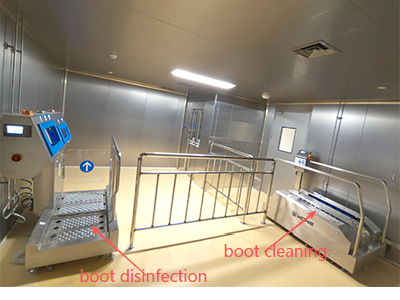
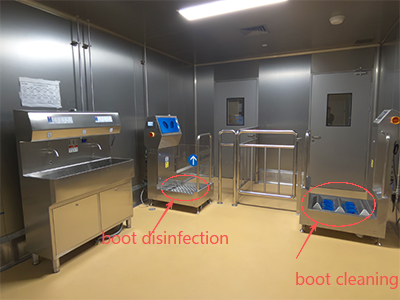
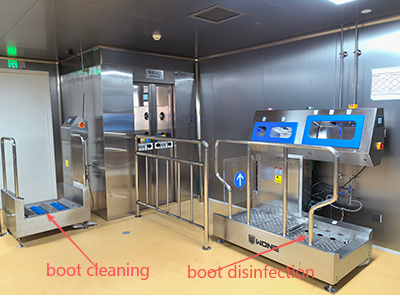
1. Cleaning when leaving the workshop: Installing a passageway-type or independent boot washing machine at the exit of contaminated areas removes most physical dirt
immediately. This protects the cleanliness of the changing room and significantly reduces the burden on subsequent disinfection pools.
2. Disinfection before entering the workshop: Setting up a disinfection pool with controlled concentration and time at the entrance of the clean area kills residual
microorganisms.
This closed loop ensures that the disinfection pool works effectively within its design range, and its effectiveness can be verified and monitored.
Beyond Controversy, Focus on Risk Control
The answer to "whether boot cleaning is necessary" should not remain a debate over literal standards, but should be based on a scientific assessment of the factory's specific
product risks, process characteristics, and contamination load.
For most modern food factories, especially when facing audits of systems such as BRCGS and HACCP, "effective cleaning" has become an indispensable prerequisite for
achieving "effective disinfection." Investing in a systematic boot washing solution is not only a technical choice to improve disinfection reliability, but also clear evidence of the
factory's forward-looking risk management capabilities. It conveys a clear message: we control not only the bottom line of compliance, but also the upper limit of safety.


