

HACCP Personnel Entry Control Systems for Food Processing Plants
Personnel entry is one of the most vulnerable points in a food processing facility. Every person entering a production area—whether an operator, supervisor, or visitor—carries potential
contaminants on their shoes, hands, and clothing. Without a properly designed entry control system, these contaminants become direct vectors for cross-contamination, potentially
compromising the safety of the final product.
According to the Codex Alimentarius General Principles of Food Hygiene (CXC 1-1969, 2020) and GFSI-benchmarked standards such as BRCGS Issue 9 and IFS Food, an effective
personnel entry control system is not optional—it is a mandatory component of a robust HACCP-based food safety plan.
The Two-Layer Structure: GHPs and HACCP
HACCP does not operate in isolation. As the 2020 Codex clearly states, HACCP is built on a foundation of prerequisite programmes (PRPs)—primarily Good Hygiene Practices (GHPs).
Personnel entry control spans both layers:
- GHPs control the general environment:
Hand washing facilities, boot dips, and changing rooms create a baseline level of hygiene for all personnel.
- HACCP controls specific significant hazards:
When a particular pathogen (e.g., Listeria monocytogenes in a ready-to-eat slicing room) poses an unacceptable risk, the entry point becomes a Critical Control Point (CCP) requiring
validated control measures.
The key distinction:
GHPs reduce the likelihood of contamination; HACCP ensures specific hazards are prevented, eliminated, or reduced to an acceptable level at a defined CCP.
Key Components of a HACCP-Based Entry Control System
1. Zoning and Physical Separation
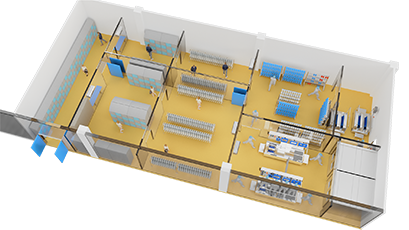
The first principle is a logical, unidirectional flow from "dirty" to "clean." BRCGS Issue 9 (§4.3.2) requires factory maps showing personnel routes. The ideal sequence includes:
- Outer shoe removal (dirty zone)
- Personal item storage
- Hand washing before touching clean workwear (clean zone)
- Workwear donning (clean zone)
- Footwear change or boot cleaning
- Final hand and boot sanitization
2. Mandatory Sequential Hygiene Station
A simple sink or footbath is insufficient for HACCP-level control. The 2020 Codex emphasizes the Clean-then-Disinfect principle—organic matter must be physically removed before
disinfectants can work effectively.
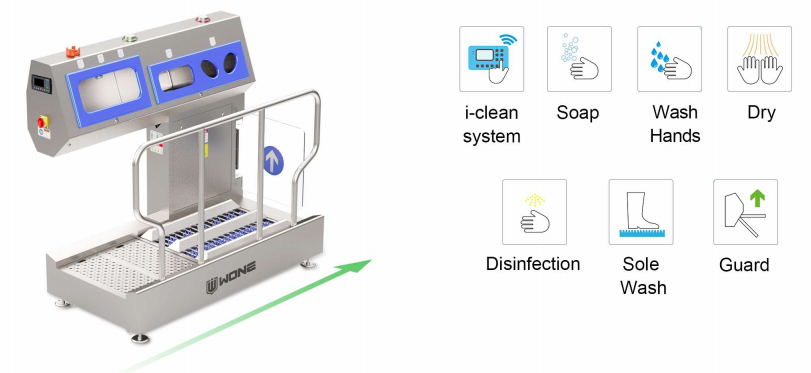
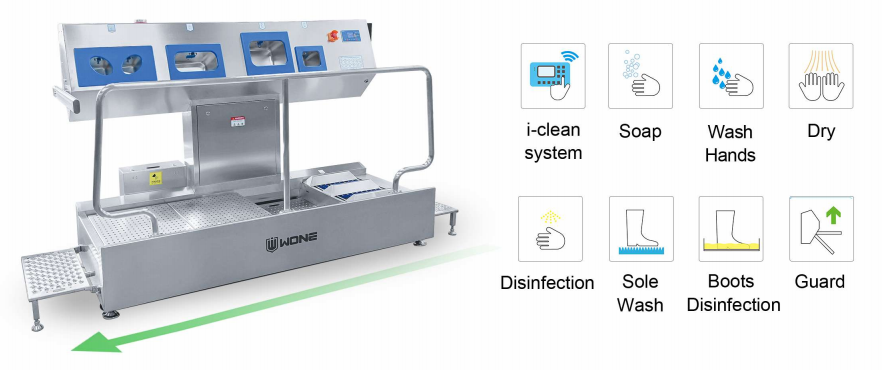
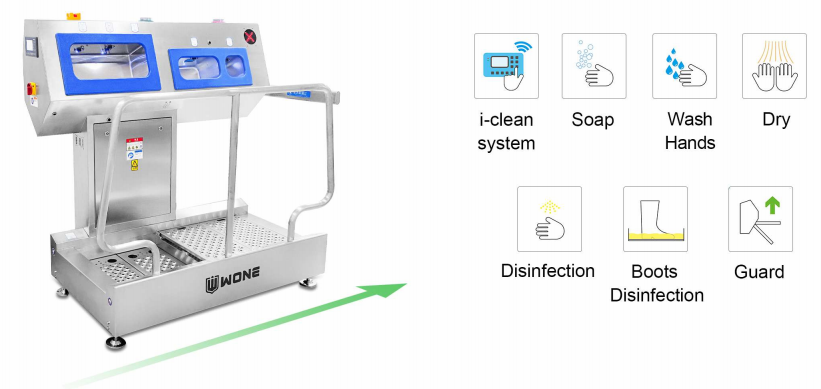
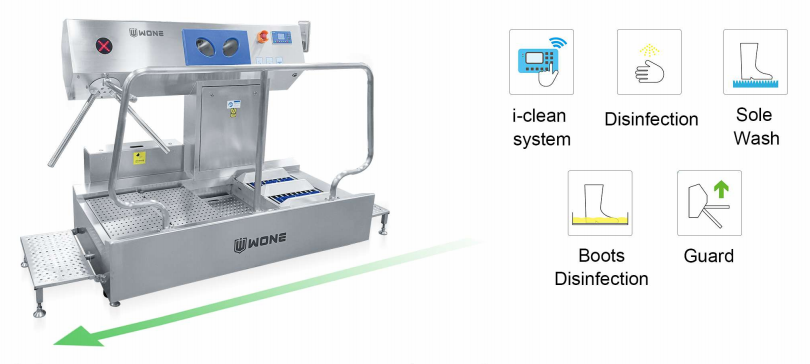
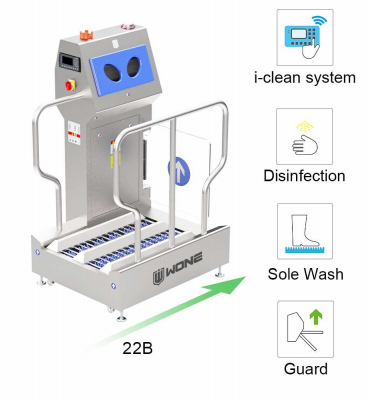
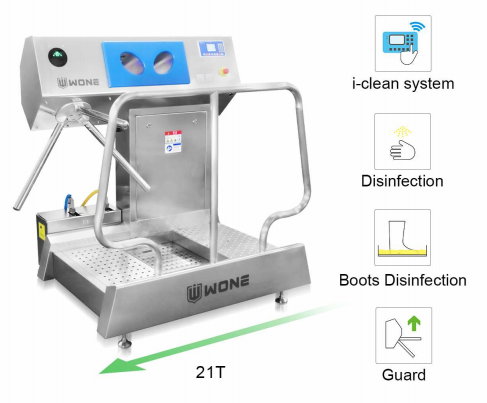
An integrated hygiene station (e.g., WONE's PBW series) enforces this by combining:
- Boot washer with rotating brushes to physically remove soil
- Boot disinfectant bath with concentration control
- Hand washing station with touchless faucets
- Hand dryer or towel dispenser
- Hand sanitizer dispenser
- Turnstile or gate that only opens after the complete sequence is finished
_____________________________________________________________________________
______________________________________________________________________________
________________________________________________________________________________
___________________________________________________________________________________
 -
- 
This creates a mandatory, verifiable, and auditable process that transforms personnel hygiene from a human-dependent activity into an engineering-controlled HACCP measure.
3. Monitoring, Verification, and Corrective Actions
For any entry control point to function within HACCP, it must be:- Monitored:
Is the sanitizer concentration correct? Are brushes spinning? Is the turnstile functioning? The i-clean controller (standard in WONE stations) logs cycle counts, water usage, and alarm
events in real time.
- Verified:
Periodic checks confirm the system is working as intended—calibrate chemical dosers, inspect brush wear, review data logs.
- Corrected:
When a deviation occurs (e.g., sanitizer concentration drops below limit), the system must alert staff and define pre-determined corrective actions (e.g., isolate product, re-sanitize, halt
entry).
.png)
In a word, an effective HACCP personnel entry control system is not a single device—it is an engineered combination of zoning, mandatory sequential hygiene processing, automated
chemical control, and data-driven verification. By transforming the entry point from a passive checkpoint into an active, monitored CCP, food processors can meet the rigorous
requirements of the 2020 Codex Alimentarius, pass GFSI audits, and—most importantly—protect consumers from preventable food safety hazards. WONE's PBW series hygiene
stations are designed to fulfill all these requirements, providing a proven, integrated solution for the most demanding food factory environments.


